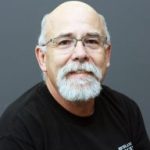
MANSFIELD — Jim Odson saved his first life when he was just 15 years old.
There are some jobs you just know you were born to do.
The first paramedic in the history of Mansfield Fire Department, Lt. Odson officially retired Wednesday morning after 34 years of service to city residents.
It was a bittersweet moment, to be sure, walking away from Station One on East Third Street for the final time, his hair now thinner and grayer at age 56 — and with his first grandchild on the way.
It was a career that saw the MFD begin to transport patients for the first time …. dealing at times with contentious contract negotiations with city administrations … surviving a state-ordered fiscal emergency that rocked an entire community … and undergoing massive technological changes in the fire services over the last 34 years that Odson had to learn (and teach).
What will he miss most when walks out the door?
The same thing that kept him on the job since Bill Clinton was elected president.
“The camaraderie … being with the guys … with the crew,” said the Madison High School graduate, who favored keeping a rank in the MFD that allowed him to remain active with the men and women rushing out the door each day.
“(Moving higher than a lieutenant), it would have been a disconnect with the guys directly. That was never a desire of mine. I wanted to be with the guys in the streets,” Odson said.

A lifetime of saving lives began in Mifflin Township
Perhaps the memory of that first life saved went through his mind on Wednesday morning.
Odson joined the fire service through a Boy Scout Explorer program when he was 15 in the Mifflin Township Fire Department.
He and another Explorer were in the station when a man rushed in with his daughter, maybe 9 or 10 years old. The two teens were the only ones at the firehouse.
“She had suffered an asthma attack and she had quit breathing. She had actually lost her pulse,” Odson remembered.
“We did CPR and brought her back and as far as I know, she did well in life and thrived after that.”
Trained in the life-saving technique, it was the first time Odson had actually attempted it on a person. What was going through his mind?
“Oh, my gosh … nothing but probably panic,” he said. “It’s just this girl is not breathing. She doesn’t have a pulse. And we just have to do what we can do to try to correct that.”
The teenager with Odson contacted adult firefighters, who raced to the station and transported the girl to the hospital.
It was the launch to a medical rescue career that Odson had an interest in since he watched the old “Emergency!” television show in the 1970s, featuring “Squad 51” saving lives in Los Angeles.
He joined the Washington Township Fire Department at age 18, earning his paramedic licensure through Grant Medical Center in Columbus in 1989. Odson was selected the township’s assistant chief when he was 19.
He began working at the former Mansfield Ambulance Service and also for the Shelby Ambulance Co., joining the MFD in 1992 as the department’s first paramedic. At the time, the MFD rescue squads went on 911 calls, but private ambulance companies handled emergency transports.

MFD began transporting emergency patients in 2004
That changed in April 2004 after city voters adopted a change that allowed the public fire department, founded in 1884, to begin taking injured and ill residents to the hospital inside publicly owned rescue squads for the first time.
Odson, who had seen the transport issue from both sides, said private ambulance companies –faced with doing primarily out-of-town and non-emergency transports — knew they would lose quality people to the public fire department.
“The EMS 911 call system is an attractant to young EMS people. You can pull young EMS quality people into that. The private ambulances (after the change) primarily made their money on facility-to-facility transports or out-of-town transports,” he said.
“That’s not very glamorous. So when they were losing the 911 system, they knew they were going to lose some quality people because of that reason.
“I think that’s why there was a lot of turmoil going on. They didn’t want to give that up. They felt the fire department couldn’t do as good of a job. (But) it’s not about department versus department.
“It’s about the people that are actually performing their job. They’re the ones that allow that system to shine or to fail,” he said.
Odson, like all the men and women hired into the MFD now, is a dual-service firefighter — able to fight fires and also work as a paramedic. New hires have two or three years to earn their paramedic licensure.

Changes in technology improves emergency medical care
Keeping up with, mastering and teaching changing medical technology has been a big part of Odson’s career.
It used to be 911 calls were more narrowly focused — heart attacks, car crashes and major trauma. Paramedics stabilized patients and then rushed them to the hospital, where most real treatment began. Training standards existed, but they varied, and communication with hospitals was limited.
Paramedics today are frontline healthcare providers, not just transporters. They transmit emergency patient data to hospitals in real time and use advanced equipment once found only in emergency rooms.
Odson said the biggest changes have come in the advancement of what paramedics can do. They can administer more drug therapies on the scene and during transport.
The MFD’s high-level cardiac care, was recognized with the 2026 American Heart Association Mission: Lifeline® EMS Gold Achievement Award for excellence in heart attack and stroke treatment.

The city’s paramedics use advanced technology, including LUCAS chest compression systems and LIFEPAK 35 monitors to transmit real-time EKGs to local hospitals, specifically OhioHealth Mansfield Hospital and Avita Health System
“The advancement in pre-hospital care is significant,” Odson said. “Technology-based applications are the biggest change.”
The core of the job hasn’t changed. Paramedics respond when 911 calls come in 24 hours a day, seven days a week and are expected to deliver a high level of medical are.
“No, that has never changed,” Odson said.
Emergency medical services dominate MFD work
The paramedic work is far busier than the firefighting with nearly 13,000 EMS runs in 2025, about 85 percent of the department’s 911 responses.
Odson attributed that to better fire-prevention efforts, including education and smoke detectors and even cell phones.
“We have a lot fewer fires and people can call 911 a lot quicker today. The fires aren’t getting nearly as big today as they were in the ’70s, ’80s and ’90s. Once we get there, we can knock them down quicker. It’s usually just the room and contents,” Odson said.
He said increased EMS calls are also an example of a national medical system in need of change.
“A lot of people don’t have a primary care doctor. So they’re using the (hospital) emergency room as primary care, which it was never designed for that purpose. The system gets overloaded.
“A lot of the younger (paramedics) make the comment they feel like they are just a glorified taxi driver to take someone to the hospital,” he said.
“That is the case, at times, but there are a lot more times where we can intervene on the medical side, to make a difference, to get the (patient) further care once we get them to the hospital,” Odson said.
On the other hand, he has seen and helped fight his share of big fires, including the Mansfield Coliseum roller skating venue at North Lake Park in 2005.
“That was the most memorable, biggest fire that I think I have been on in the city of Mansfield,” Odson said.

‘You have to have the desire to come into the fire service to really make it a career’
Would he recommend the fire services to young people today?
“If they have the desire,” he said.
“What we’re seeing now, and it’s nationwide, not just Mansfield, is it’s not as glamorous as it used to be. You can make a lot more money doing other things
“But you have to have the desire to come into the fire service to really make it a career. It can’t just be a job. We want to look at it as a career. We are here for 25 years before we are eligible to retire within our system.
“Every four years, the administration is changing with the city, they have new ideas and a lot of it is just misunderstanding how the fire service operates. It’s not 9 to 5, 40 hours a week. We’re here 24 hours a day. It’s a third of our life.
“Sleep deprivation is probably the most detrimental thing. And the older you get, it’s harder. It takes longer to recover.
“We just want this to be a place that is safe. Safety is number one for us … and then make it a good career and have a good living,” Odson said.
“If you don’t have a desire for this … it’s not what you think it is.”
‘I will be as busy as I want to be’
Odson and his wife, Leanne, have successfully raised three children, now busy with careers of their own. Their first grandchild is on the way.
One of their sons is a new veterinarian. A daughter just graduated from college with a degree in digital media production. Their oldest son is a commercial roofer.
Lookimg ahead, Odson said he will do some work for private companies in the fire prevention business, as well as investigative work for insurance companies.
“I will be as busy as I want to be,” he said with a laugh. “And then I just want to relax.”