


PANAMA – Two young Dutch women, Kris Kremers (21) and Lisanne Froon (22), went for a hike on the El Pianista Trail in the jungles of Panama and were never seen alive again.
On April 1, 2014 they set out on the trail. On June 14, their blue backpack with a Canon PowerShot camera inside was discovered on a riverbank by a local from the village of Alto Romero.
For 10 days, phone data showed Froon’s Samsung Galaxy S III and Kremers’ iPhone 4 were powered on and off, along with attempts to call emergency numbers to no avail with no reception.
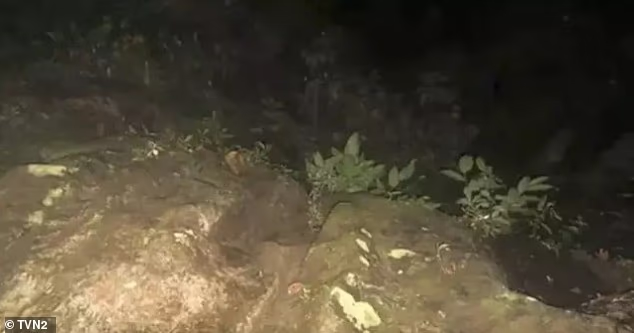
On Day 8, the PowerShot camera revealed 99 strange photos taken between 1 and 3 a.m., mostly of the black night sky, a rock with a stick that appears to have red bags tied to it and one bizarre photo of hair.


Thirty-three bones would be located in the weeks that followed finding the backpack, scattered along the Culebra River, matching the DNA of the young women.
Source Media interviewed one of the world’s experts on the case, Frenchman Romain Casalta, from his home in Paris, in an attempt to piece together exactly what happened to the young women.
Kremers and Froon were in Panama set to volunteer at a school in Boquete, and had an unexpected couple of days before classes started to explore the area. So they decided to do the El Pianista Trail, a well-established 2.5-mile hike up (1,923-foot elevation gain) to a stunning overlook of the rolling hills of the jungle.
Adam Doc Fox: What did the women have with them?
Romain Casalta: What we know comes from the photos and what was found in the backpack. They had their clothing: shirts, jeans, boots. They had no flashlight, besides their phones, which of course have lights. They also had a camera with a green light that could be used as a flashlight. They carried sunglasses, a camera cover, a keychain, a key, an insurance card, and two bottles of water. We can speculate about snacks because one “night photo” shows what looks like a Pringles lid. There may have been a tourist map of Boquete as well, since papers in a “night photo” resemble a map seen earlier in their pictures. But nothing for a long hike — no water purifier or survival equipment.
NOTE: The young ladies reached El Mirador, or the summit/overlook around 1 p.m, according to the timestamps of the summit photos from the recovered camera. They took a bunch of pictures and seemed to be happy and safe.


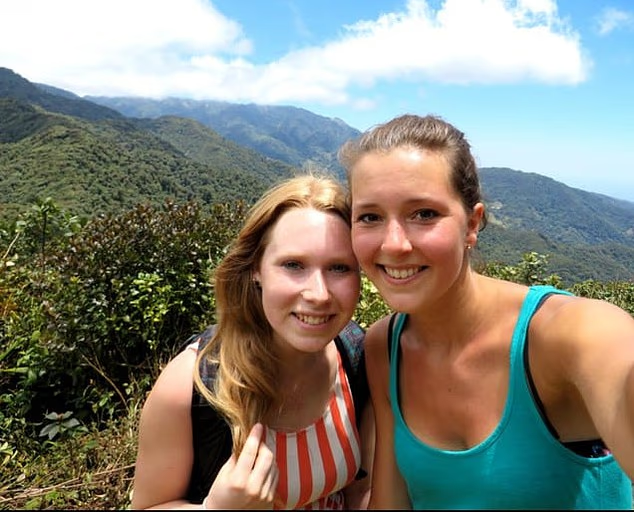
Instead of descending down the same route and back to the trailhead from the summit, they followed the path descending the other side of the hill.
Pictures and timestamps later in the afternoon confirm this, with the last one being at 1:54 p.m. Casalta himself went to the exact spot and confirmed this on one of his expeditions. The women again seem content and unharmed in the photos.


Things had gone horribly wrong, however, as at 4:39 p.m. the women tried calling 112, the Dutch emergency number. Something happened; were they hurt or lost, maybe an animal attacked, was there an evil human lurking?
Both phones were powered off on April 1 at 5:52 p.m. They knew they were in the jungle for the night.
ADF: What do you think happened at that moment [to make them call the emergency number]?
Casalta: That first call is significant. At that time there were still at least two hours of daylight. Even in vegetation it would be dark later, closer to 7 p.m. They had phone flashlights, they could have walked back or even spent the night on the trail — it shouldn’t have been a major problem. Also, there’s a three-hour gap between their last tourist-style photo and the emergency call. That suggests a change in mindset. Something happened in between. But the timing of the call doesn’t mean the incident happened right then — it could have happened earlier and they tried to manage it first.
I don’t think it was animals. Most large animals there are nocturnal. I’ve spent plenty of time in the area, Jaguars are rare, but we know there’s one in the area because of the horse.
ADF: Horse?
Casalta: You said you looked at my drone footage, maybe you saw, do you remember the horse?
ADF: I don’t remember the horse. I remember you specifically talking about camping and how you would just listen and you would try to, in a sense, re-enact what it was like to be in that solitude and how you would hear noises at night but in the daytime there really weren’t any. But tell me about the horse.
Casalta: On the video, two horses are dead now because one was killed by a big cat and then one year later another one was killed again. So there is definitely a big feline in the area, but they are just very hard to meet like they are mostly active at night.
Snakes usually avoid humans, but you should be careful with that of course because, one bite, depending on the species, could kill you in 30 minutes. But it doesn’t fit what happened to the girls, because if it was because of a snake to one of them, at least one of them would be dead, quickly, in a few days at least, a few days after the disappearance and so, unlikely.
Something we don’t think about is wild pigs. So they have, for example, a species in Panama called [peccary] and it’s a type of wild pig and they are very aggressive, and I know someone, a local friend, that was actually attacked at the first “monkey bridge,” and he was bleeding and they killed the [peccary].
But that’s something that could happen in the area. But it’s very rare because it’s the only person I know there who had such an experience.
An injury is possible, but they were two people — one could have helped the other — and they weren’t found on the trail, which is strange. They shouldn’t have been led to be found so deep in the jungle.
Many people speculate that they could fall off the trail. I’ve climbed steep areas, much steeper than what’s on the trail, I could climb it without equipment, you have a lot of vegetation. So it doesn’t make sense to me that they would fall and not be able to get back up [to the trail].
ADF: That matches what I saw in your trail videos. I’m a mountaineer and a climber, so I examined the terrain and then studied a couple other of your reports where you’re talking about 70% grades, but with vegetation and things like that so I agree.
But wasn’t there a foot bone that looked like it had a fracture?
Casalta: Yes, possibly a metatarsal fracture, as mentioned in the Dutch report. But I don’t see it mentioned in the Panamanian police report. I’m supposing it could have happened from walking upstream on river rocks and jamming a foot between them. But the Panamanian autopsy didn’t mention it.
ADF: OK. So injury seems unlikely. What about getting lost?
Casalta: The trail is straightforward — one way in, one way out. The day was clear, no mist, so no confusion possible with direction. And if they did step off the trail, the slopes help guide you back.
Their short jeans and just a t-shirt, light clothing also makes it unlikely they’d push deep into vegetation, voluntarily. It doesn’t make sense, like out of curiosity, to go that deep. People would actually get scared going 10 meters in. So I don’t think simply “getting lost” fits either. There are of course stories of people getting into the vegetation and later getting lost. However, they have to be put in their own context.
There was for example, in 2015, a couple that got lost on the Lost Waterfalls Trail. The difference is they wanted to have a shortcut, which the proximity of the town to the trail made that thinking possible. In the end, they were very quickly found.
ADF: Those are great points because I’ve hiked in the jungles of Costa Rica. So kind of similar, Central America, to Panama, and it’s super thick. If you go off trail you can’t really even go off trail. You can’t walk, you know?
But I also understand from climbing and all the all the places that I’ve been in the backcountry, with no cell reception, I’ve had different maps and and things like that, but how easy it is to get turned around, you know what I mean? It doesn’t take much for you to get disoriented. So that’s the only thing. I agree with you, but I also know what I’ve experienced, that it’s so easy to get disoriented.
But either way, at one point they went off trail. You don’t think it’s animal, that they got lost or injured, what else?
Casalta: A human encounter is possible. During my expeditions, around 2 p.m. near the first stream, it’s common to meet people coming from the Caribbean side. It’s strange no one reported seeing them there.
Another possibility is some unknown natural event. Something we don’t know about.
But overall, I believe they were put in a situation, where they were far from the trail and could not get back to it. So that’s all.
ADF: Let’s talk about the phones, over the next 10 days, they are attempting to call for help at different times, but had no reception. We see phones, powered on, powered off, but on day 7 to 10, there’s no activity on either phone. So, why do you think that was? Were they in the same place? Were they immobilized? Was there sickness starting to happen from bug bites? Bad water?
I read something in “Estrella de Panama” that you were talking about poisonous plants even? From days 7 to 10 there’s no activity. Why? [Note: there’s activity in the morning of the 10th day, we’re talking about the gap between].

Casalta: Likely exhaustion and lack of options. They had tried many times before with no success, and by then they had no food for a week, and probably moved around a lot.
They were maybe in an area I called “the belt,” which is very rough terrain. So the inactivity would be explained by this combination of exhaustion and a lack of options.
ADF: In the middle of that no activity period, on Day 8, there are the night photos — 90 to 100 of them. It gives me goosebumps to think about.
What is your interpretation of those photos? It’s in the middle of the night, most of them look to be pointed at the black night sky, you see certain things, the big rock, the branch with the red bags tied to it. What do you think is truly happening? Are they trying to scare off an attacker? Or did they, like you talked about that one night you saw some light, maybe a fire, but in the morning, it was nothing? What what do you think was happening? What’s the most significant evidence you found in those photos?
Casalta: There are two possibilities. One, I think they were trying to signal their presence. The photos are mostly in the same direction and taken in quick succession, suggesting they used the flash as a light, not to take pictures. Not to light the area — they already knew it — but to try to be seen. They could have used the green light of the camera to see.
But signal to whom? Possibly a rescue team, but that’s highly unlikely because I don’t have [I’m not aware of] any rescue team in that area at night. And even if there was, Kris and Lisanne were most likely in a river or in a stream, because the pictures seem to lead to that. In that kind of area they wouldn’t be able to see something like that.
The shots, the pictures were tilted, not towards the sky directly, but in a side inclination. But maybe a natural phenomenon that could be interpreted as human activity.
ADF: What about the light you saw when you were investigating this case and camping in the jungle?
Casalta: I was very late on the trail and I met a native who was also late on the trail. So I assumed that he went to sleep in the vegetation. I thought I saw a campfire at night, but the next morning I saw that it wasn’t a fire because it would have been on a slope with no sign of human activity.
You also have insects in that area [like lightning bugs and fireflies], but no insect to my knowledge that could do such a light.
There’s a natural phenomenon, when I was sleeping alone near a stream in that area and I woke up at 2 a.m., and with the water flowing between the rock, it made a strange sound, like sounded like a human voice talking. For a moment I really thought someone was speaking.
In that type of situation, something I noticed from my own experience there, where I start to lose my mind a little bit. So that’s something that could have happened to the girls, since it was eight days since the disappearance.
MORE COLD CASES & UNSOLVED TRUE CRIME


ADF: What about animals?
Casalta: I doubt it was to scare animals, because the angles don’t point downward.
ADF: What about the close up hair photo of Kris and the red plastic bag photo with the branch?
Casalta: The hair photo was likely accidental — Kris just got in front of the camera between shots. There was not a lot of time between the three pictures. But what we can see on the hair picture is that the camera had the time to focus on Kris [in order] to take the picture. So that’s information, but the fact it was taken so close to the previous picture and the next pictures seems like Kris just got in the way and uh and it’s just a mistake.
For the red “bags,” explanations are harder. Maybe an attempt to signal from above, or to mark something. It is kind of mysterious why they did that.
Using it to fetch water doesn’t make sense since they had bottles and were near a stream.
One thing I speculate about the night pictures is that they were on a big rock.
ADF: Then on Day 11, Kris’s phone is turned on for the last time. Do you think that’s when they died?
Casalta: I think it’s possible they stayed alive a few more days. Ten days is about the average survival limit in the jungle without food or training. They may have lasted a few more days, but the last phone activity shows they stopped conserving battery — maybe a final attempt, or maybe they gave up.
We found bones, but due to the state of decomposition, you have to make a guess of when they died.
When I was in the Paddocks (an area near the trail in the jungle), I saw a cow and when I came back three weeks later it was just bones. But it was down to bones in just three days they told me. Very fast.
ADF: You’ve done multiple expeditions and you just got back from one in Panama. What did you find on your most recent one, the 8th one?
Casalta: I had two goals: one, to check potential night photo locations from a sponsor and another location that was my own that I wanted to check.
What I can say, because I have to be careful because I am involved in a documentary, but I found a location that I think is interesting. It is the best one so far I’ve found.
I may ask the public to compare the night photos with the pictures I took. The place felt surreal, with the V-shaped tree and large rock.
And two, to visit Alto Romero, where locals found the backpack and bones. In Alto Romero, I spoke with the couple who found the backpack and did interviews. They and their community are very reserved but kind. If they pass you on the trail, they may not say anything, but it is because they are shy. When you get to know them they are always very nice and careful.
ADF: How was the police investigation when the bones and pack were found?
Casalta: I don’t believe there was a cover-up — just poor-quality work by police at times. They could have gone deeper in their interviews, stronger analysis of the backpack and contents of the backpack, of the bones.
Were there marks on the bones from the rocks, but on the autopsy report I don’t see any mention.
They should have hired the correct people to explore the trail. I was told one man hired to check the trail to the “monkey bridge” didn’t know well the area. Why not take the locals? And to explore the area east to the trail before the first bridge? Starting the search from the last known location of a missing person is a very basic step. What’s more, many people claim to be expert of the mountain but actually few leave the trails and are able to explore the nature safely.
ADF: What about the missing photo 509?
Casalta: It could be deletion by the girls, a technical error, or a later mistake by investigators. We can’t know. There’s no definitive sign of foul play in that alone.
ADF: I don’t know exactly what put them in a state to call 911, but my contention is they got lost. They went off trail just a little bit to take a photo or up a river a little bit and just they got lost. Ten days of survival.
The night pictures, I agree 100%. They were trying to signal something and then I think they both died close to the riverbed. That’s why the water was able to to rise or the rains were to come in and take them downstream. And like you’re saying, the bones being able to be picked apart like that, that would make sense because [the bones] didn’t travel that far down the river, and then they’re found.
Do you have an official theory as to what what exactly forced them off trail? Was it a snake bite? Did they get lost? Was there somebody that pointed them in the wrong direction? What made them start on that journey, you know, into the jungle? So what’s your personal theory as to what happened to Kris and Lisanne?
Casalta: I think it’s a mixture of two scenarios. You have the accident scenario and then you have the criminal scenario. By criminal for me I mean human intervention, not necessarily the “criminal” scenario.
Maybe they met someone, got misled or frightened, and ended up stuck far from the trail.
From there, it became a natural death: exhaustion, hunger, and exposure. The beginning is the hardest part to explain — why they left the trail in the first place.
ADF: That makes sense. Thank you for this. Anything you want to promote?
Casalta: I have a YouTube channel under “Romain C” where I share updates, and I’m developing a production company with a friend called Noctua Horizon for documentaries and corporate films. A full documentary on this case is in development as well.
ADF: Perfect. Thank you so much — this was amazing.
Casalta: Thank you.

Youtube (Romain C): www.youtube.com/@Romain_C
Noctua Horizon: https://noctuahorizon.com/
Links to the blogs of ImperfectPlan and CamilleG:
ImperfectPlan: https://imperfectplan.com/kris-kremers-and-lisanne-froon-case-articles/
CamilleG: https://camilleg.fr/category/projet-panama/