MANSFIELD — Patricia Lewis thinks Richland County residents could learn a lot from a Winslow, Arizona native.
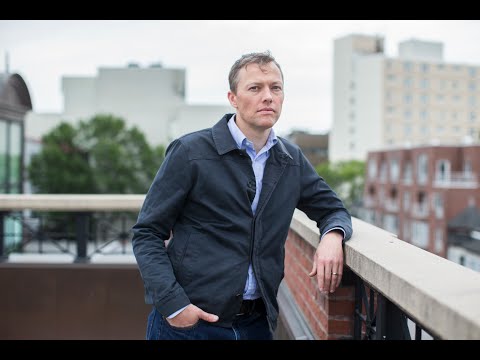
Lewis attended Tuesday night’s Kaleidoscope Community Conversations with author Matthew Desmond. Desmond is a sociology professor at Princeton University and the principal investigator at The Eviction Lab.
His research focuses on poverty in the United States, housing insecurity and public policy solutions. Desmond was the second of four speakers featured in the Kaleidoscope Community Conversations series.
Desmond’s work includes the Pulitzer Prize-winning book, “Evicted: Poverty and Profit in the American City,” which tells the story of the eviction landscape in Milwaukee, Wisconsin.
Lewis, a teacher at Lucas Local School District, said Desmond’s message of hope and an “abundance mindset” encouraged her.
“I really appreciated Dr. Desmond’s stories of hope and that we can make a difference,” she said.
“Also, the idea that we can eradicate poverty isn’t exactly one I grew up thinking about or hearing, so to hear it and how it would be as simple as making people pay the taxes they owe, that kind of blew me away.”
Randy Lewis, Patricia’s husband and a bus driver for Mansfield City Schools, said the stories and statistics of children living in poverty resonated with him.
“When he mentioned that a percentage of students who start the year don’t finish the school year because of moving around or different reasons, I see that on a monthly basis,” he said.
“A couple years ago I was talking with a kid toward the end of the school year and I asked if he was excited for summer. He said, ‘Not really. At least during the school year, I know I’m going to get fed, and I never know when I’m going to eat next during the summer.’
“We have five kids and even when we were below the poverty line, they never had to worry about were we going to eat.”
Eliminating poverty
Jay Allred, Source Media Properties CEO, moderated Tuesday’s conversation with Desmond.
He cited Census Bureau statistics that 25% of Mansfield residents live at or below the poverty line. 13.6% of Richland County residents live at or below the poverty line, which is higher than the statewide and national averages.
“I think the biggest myth about poverty in America is that we have to live with it,” Desmond said.
“It can end. It would cost about $177 billion a year to bring everyone who is currently below the poverty line above it.
“A recent study showed if we just make the richest 1% in this country pay the taxes they owe, that could nearly close the poverty gap,” Desmond continued. “That would generate $175 billion a year.”

Desmond pointed to COVID-19 economic relief as an example of “functional government.”
“When the government wants to function at a high level, it certainly can,” he said. “There’s usually all this red tape and bureaucracy when it comes to getting people help.
“In Oregon, 100% of the people eligible for food stamps get food stamps, but in California, it’s only about 63 percent because you have to answer so many questions just to feed your family.
“That’s not a picture of welfare dependency, that’s a picture of us not doing a good job of connecting people to what they need.”
Desmond also discussed affordable housing and examples of successful programs around the country to build homes and protect people from evictions.
“Developers would much rather build multi-family properties even if there’s a cut of it that needs to be affordable,” he said. “So if we want a market solution to ending poverty, we have to get serious about opening our communities.
“A lot of us have these old ideas of affordable housing, but it is getting much better. These places have grass, playgrounds and nice buildings now. Affordable housing and inclusionary zoning is needed to keep advancing that.”
Desmond said residents can visit endpovertyusa.org for resources on getting involved in poverty abolitionism at the local, state and national level.
“The beautiful thing about poverty eradication is, wouldn’t it be great to raise kids and not have that pit in your stomach that you know the kids could fall all the way down into poverty? I don’t think we should have to be superhuman to escape poverty in this country.”
Local resources
There are a number of local organizations addressing poverty in Richland County. Here are some services that can help.
- The Mansfield-Richland County Public Library will start free backpack meals every Thursday at the main library on Mansfield’s Third Street. The bags are available to children under 18 starting at 4:30 p.m. through open hours while supplies last. Each bag will contain two breakfast items, two entrees, and two snacks.
- The library’s First Call 211 service also compiles information on food and housing resources, financial assistance information and more. May’s free meal calendar is available at this link. Free, fresh produce distribution sites are available at this link. A list of food pantries and their hours is available here.
- Third Street Family Health Services provides healthcare to underserved populations, both with and without health insurance. According to development director Alex Goff, about 60% of Third Street’s patients receive Medicaid. The nonprofit has also started transportation services to and from care appointments.
- The Domestic Violence Shelter of Richland County, Wayfinders Ohio, Mansfield Metropolitan Housing Authority and Catholic Charities also offer a number of services to connect people with resources.
Kaleidoscope Community Conversations aims to bring together thought leaders, innovators, and changemakers to engage in meaningful dialogue on pressing social issues.
Allie Watson, president of the Richland County Foundation, said she was happy to see so many attendees at Tuesday’s event.
“Tonight and the last time in January, I’m blown away by the number of people in the audience,” she said.
“There were more people in the crowd tonight than there were for Majora Carter, and I hope that continues to grow.
“I think the more educated we are and the more information we have, the better choices we can make as a community moving forward. I think the more people we have in the audience, the better conversations and the more solutions we can find in the long term.”
The next Kaleidoscope event features Amanda Ripley, a New York Times bestselling author and investigative journalist. Her research focuses on healthy conflict resolution. Tickets for the August 29 event are available at a pay-what-you-can model.
The Kaleidoscope Series event is made possible by the generous support of sponsors including the Richland County Foundation, Mansfield/Richland County Public Library, Renaissance Performing Arts Association and Richland Source.